Showing posts with label digital hearing aids. Show all posts

Monday, 24 June 2013

Digital Hearing Aids St Helens –Merseyside Digital Hearing Aids

Digital Hearing Aids St Helens –Merseyside  Digital Hearing Aids 

Two distinguished business families have been associated with St Helens in Merseyside.  Thomas Beecham’s factory set up in the late 19th Century was to become one of the largest pharmaceutical manufacturers.

 Thomas Beecham started his working life at the age of eight when he became a shepherd.  However this early occupation paved the way for his later business empire as this was where he learnt about herbal medicine.

 When Thomas arrived in Wigan he sold his own preparation called Beecham’s Pills, a laxative in pill form.  They were sold as a ‘cure-all’ remedy but had definite and positive affects on the digestive system.  By 1860, he had moved to St Helens and now started marketing the pills as well.  He sold through a network of agents in Lancashire and Yorkshire.  The next move was to build his own factory in the town.

 Shortly after this, his son Sir John Beecham (1st Baronet of Ewanville) joined his father’s business.  He was responsible for developing it further – opening a factory in New York and in other countries.
Joseph’s son didn’t follow the family footsteps into the pharmaceutical business but you’ve probably heard of him.  He was Sir Thomas Beecham the well known conductor and founder with Sir Malcolm Sargent of the London Philharmonic Orchestra.

The Pilkington family
The other famous commercial family who made their mark on St Helens were the Pilkingtons.  They founded the glass works with another family, the Greenalls.  When the line of descent of the Greenalls disappeared, the company became known as Pilkington Brothers and then much later as the Pilkington Group Ltd which was taken over by the Japanese company NSG Group.  They remain in St Helens producing flat glass a technique they pioneered in the mid 19th Century.

Do you live in St Helens?
If St Helens is your home town or where you live now you might be interested to know about our services.  Hearing tests are easy and we can conduct them in your home if it helps.  Failing or deteriorating hearing can be due to a number of factors but is an isolating condition.  Don’t suffer in silence get tested and listen to our solutions.

Get in touch on 01782 698090.

Other industries in St Helens
In fact glass making was big in St Helens and was also home to Ravenshead Glass which was sold off, United Glass Bottles and Triplex, a subsidiary of Pilkington which was shipped out to India.  None of these remain in St Helens now.

St Helens like many other towns in Great Britain became more industrialised when the Industrial Revolution took hold in the 18th and 19th Centuries.  Prior to this industry consisted of home-production which by its very nature is small; this mostly consisted of linen weaving.

Cotton and Linen were two of the other local industries which got bigger during this time; others included coal mining, the extraction of clay, salt, lime and alkali, copper smelting and brewing.

Coal mining was probably the biggest industry at this time and carried on right up until the 1970s when 5,000 men were still employed at local collieries.

Greenalls Brewery was established in St Helens in the 18th Century but moved to Warrington (about 10 miles away).  After the acquisition of several other breweries around the country some two centuries later, they stopped brewing and concentrated on the management of hotels and pubs.  That was in 1991 and in the following 15 years the business was eventually divided up and sold off.  The De Vere Group bought the hotels and still serves London Dry Gin which was originally produced by Greenalls.

St Helens today
The town with its population of more than 102,000 thrives with a rich blend of commercial, urban regeneration, culture and sports.

The regeneration schemes have seen new housing and the regeneration of main shopping districts. 

There are two shopping malls here: St Helens and Ravenshead – the latter being the newer mall.

St Helens has a healthy cultural status with a thriving theatre tradition, plenty of nightlife and many parks.  Taylor Park holds the distinction of being Grade II listed – this park and gardens is of Victorian descent.  There are 22 other parks in the area.

Continuing the cultural reference a large sculpture stands at the head of an old colliery called Dream.  This 20 metre sculpture is made from concrete and was part of the nationwide Big Art Project which was televised in 2009.  The head can be seen from M62.


{{Information |Description={{en|1=View of the Dream taken from the path leading to the sculpture facing away from the M62.}} |Source=Photograph taken by Christian Keenan |Author=Christian Keenan |Date=14th June 2009 |Permission=Granted by Christian Keenan

Perhaps one of St Helen’s most famous attributes is its Rugby League club.  Playing at Langtree Park on the site that was once where United Glass Bottle production took place, the club is also known as the Saints.

Well know sons and daughter
Besides the famous business men of yesteryear St Helens, there are other well known faces that hail from the area.

·         Film director David Yates is probably best known for his production of the Harry Potter films; he was inspired to go into films after watching Jaws directed by Stephen Spielberg
·         Jacqui Abbott was the lead singer with The Beautiful South after 1994 performing some of their most successful hits including ‘Rotterdam’ and ‘Don’t Marry Her’
·         Richard Seddon made a name for himself in New Zealand where he became their Prime Minister to rack up the longest service
·         Footballer Bill Foulkes played for Manchester United and survived the disastrous Munich Air Disaster when eight of the Man U team died.  Foulkes played almost 700 games for Man U
·         Comedian and actor Jonny Vegas often seen with the PG Monkey comes from St Helens
·         Budgie aka Peter Edward Clarke is the drummer with Siouxsie and the Banshees


{{Information |Description=Subject: Budgie of Siouxsie & the Banshees Date: June 1, 1986 Place: Oakland, California, USA (Unknown hotel lobby) Photographer: Andwhatsnext Original 35mm photograph scanned Credit: Copyright (c)


·         Singer Rick Astley of 1980s fame actually had his first eight singles go into the top ten music charts
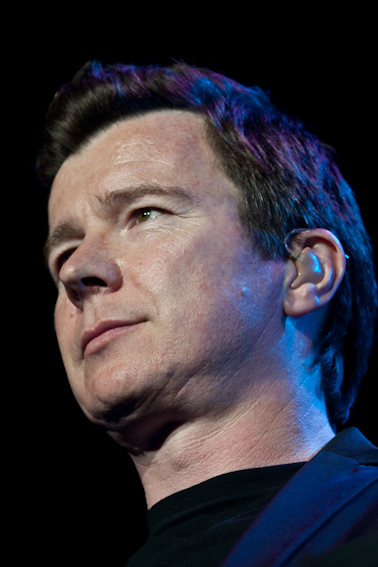


{{Information |Description={{en|1=Rick Astley performing at Pepsifest 2009.}} |Source=[http://www.flickr.com/photos/musicbook/3525997685/ Flickr] |Author=[http://www.flickr.com/photos/musicbook/ Bruno The Uploader II] on Flickr |Date=2009 |Permission={{cc

·         Entertainer Bernie Clifton maybe best known for his stage props including Oswald the Ostrich
·         Comedian Pete McCarthy and actor Pete Postelthwaite both went to school at West Park Grammar School, St Helens; the school is now De La Salle School
·         Actor Matthew Crompton who has appeared in both Coronation Street and Brookside but is probably best known for his role as PC Sam Harker in The Bill


But enough about the rich and famous, it’s all about you!  Living without good or reasonable hearing is miserable.  With modern technology there is no need to let this continue.  Talk to us about hearing tests and digital hearing aids which could make all the difference to your live.   Telephone us on 01782 698090 or send us a message using our online form

Thursday, 13 June 2013

Digital Hearing Aids Manchester


Hello Mancunians!  Or do you only answer when you’re called Mancs?  Or maybe your hearing’s not what it was and you’re not sure what we’re saying?  If the latter is the case, fear not, for Castle Hearing Aids are on hand to come to your assistance.

Get in touch with us if you would like your hearing tested.  We can send a professional audiologist to your home to carry out the tests.  It’s a simple procedure that checks the level of hearing in both your ears and this allows us to recommend a suitable digital hearing aid to help you.

Get in touch with us to talk it through or arrange a visit.  Message us here or call us on 01782 698090

Manchester in all its glory
Back to your home town.  Manchester is the third largest city or rather borough after London and Birmingham.  Its origins are from Roman Britain; it was in 79AD that Romans built a fort here at what they named Mamucian.  Now an Ancient Scheduled Monument, it was located on a sandstone outcrop close to the meeting of the rivers Medlock and Irwell.  This is now in the Castlefield area of the city.  Mamucian was just one of a string of forts built along the Roman Road between York and Chester.

What is left of the old fort – some foundations essentially – are now protected.  Although originally built from ‘turf and timber’, in 200 AD stone was used to rebuild some parts of the fort particularly the gatehouse and to face the walls.  The fort incurred a lot of damage as Manchester developed into an industrial town in the 19th Century.  Fortunately what is left is well preserved now.

A Manor town
In Medieval times, Manchester was no more than a manorial town and as such part of the feudal society of old England.  The lord of the manor owned the land and held the power and all citizens were answerable to him.

Thomas de Ware was the notable Lord of the Manor who is also responsible for founding the local church in the 15th Century and which you’ll now know as Manchester Cathedral.  Although the building already existed he got permission to turn it into a collegiate church.  This meant that it was run and looked after by a group of canons and preachers.  It is now the seat of the Bishop of Manchester.  In the 20th Century bells were cast for the bell tower where 10 bells now hang.  They are rung every Sunday as a call to service and on special occasions.  The largest bell weighs 1.3 tonnes.


== {{int:filedesc}} == {{Information |description={{en|1=Manchester Cathedral Manchester Cathedral is located on Victoria Street in central Manchester. The cathedral's official name is The Cathedral and Collegiate Church of St Mary, St Denys and St George

Chetham’s Music School occupies one of the collegiate buildings which was founded as a school in the 17th Century by Humphrey Chetham.  It started life as a charity school and later became a boys’ grammar school.  The music school was not founded until 1969.  Over the years it has seen some famous pupils pass through its doors including the actor Max Beesley, musician Mike Lindup of Level 42, classical singer Jon Christos, pianists Peter Donahoe, Stephen Hough, Paul Lewis, Leon McCawley and Andrew Wilde. A number of string and wind artists and conductors are also graduates of Chethams.


{{Information |Description= |Source=http://www.chethams.org.uk/hist.htm |Date=unknown |Author=unknown |Permission=see below |other_versions= }} Category:Mancunians

The heart of the textile industry
Manchester is known to have been granted a market in the 13th Century and about 100 years later the market attracted Flemish weavers to the area.  Some say this was the start of Manchester’s importance in the textile industry

Certainly from the beginning of the Industrial Revolution as early as the turn of the 19th Century, Manchester grew rapidly and became the hub of the textile industry with many mills.  It was during this century that it gained city status too.  It is also the era of the opening of the Manchester Ship Canal and the creation of the Port of Manchester.

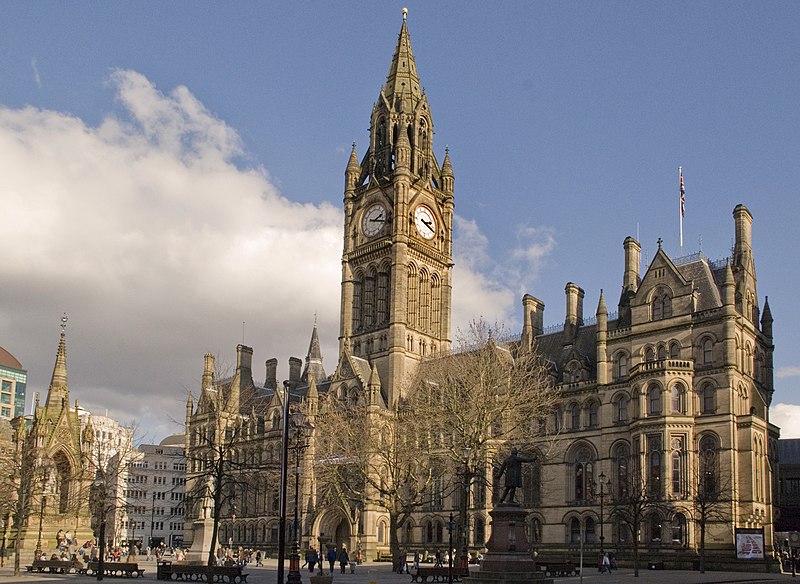
Manchester Town Hall
It was also during this age that the magnificent Manchester Town Hall was built.  The architect was Alfred Waterhouse and this was his best known building.  The clock tower which stands some 85 metres tall dominates the exterior of the building.  Inside it is probably the Great Hall which is the most impressive with its barrel vaulted ceiling and glazed windows there.  Ford Maddox Brown paintings adorn the walls telling Manchester’s history.


{{Information |Description=manchester_town_hall |Source=[http://www.flickr.com/photos/markseyesight/8265806768/ manchester_town_hall] |Date=2012-01-01 00:00 |Author=[http://www.flickr.com/people/90950116@N06 mark andrew] |Permission= |other_versions= }...

Football heaven?
Obviously as England’s third largest city we could go on and on and ... but we can’t leave the city without mentioning football.  Like many big cities, Manchester has two professional premier league football clubs.

Manchester United is based at Old Trafford, the biggest football stadium in the UK.  They have hosted most of the large football tournaments here including the FIFA Club World Cup.  Manchester United is internationally known and respected and followed by fans from around the world.  The club holds many records including:

·         20 top division titles
·         11 FA Cups
·         The most appearances in FA Cup finals
·         The first team from England to win the European Cup

Manchester City play at the City of Manchester Stadium built in 2002 for Commonwealth Games.  There is a lively rivalry between these two Manchester clubs and like Man U, City hold many trophies.  They have won

·         Five FA Cups
·         Two Football League Cups
·         In 1934 they achieved the highest home attendance for a game against Stoke City.  84,569 fans turned up.  This record still stands today

Both teams have lost significant managers this year.  Sir Alex Ferguson (Manchester United) retired in June and Roberto Mancini (Manchester City) was sacked in May.


{{Information |Description = Alex Ferguson, manager of Manchester United F.C. |Source = Cropped and lightened version of the file uploaded to Flickr with the name [http://www.flickr.com/photos/aust

Last but not least
With a city this size, we could probably do a blog just about famous people of Macnchester.  So this is just a small random selection of those who hail from or who have connections here:

·         The late Lee Rigby who was murdered on the streets of Woowich earlier this month
·         Actress and comedian Caroline Aherne
·         The Gallagher brothers, Liam and Noel of the band Oasis
·         Nobby Stiles ex Manchester United player
·         Author Howard Jacobson
·         Suffragette Emmerline Pankhurst
·         Michael Wood TV presenter of historical interest topics

Now’s the time
So back to that old hearing problem.  It can be caused by a variety of things from simple earwax build up which can be very disorientating and uncomfortable to working continually in extreme noise situations.  Sometimes it is to do with the ageing process and deterioration. 


But whatever the cause get in touch with us as soon as possible and we can help improve the problem.  Call us on 01782 698090.

Wednesday, 22 May 2013

Digital Hearing Aids Winsford – Cheshire Digital Hearing Aids


Winsford could have fielded its own football team from players born in the town.  True it would be difficult as their dates of birth – and death of some – vary tremendously.  However there are eleven football players who claim this town in Cheshire as their home town.

The original squad could be made up – roughly – of the Brittleton brothers Sam and Tom.  Sam played for Stockport County, Sheffield Wednesday, Manchester City and Southampton.  His career ended in 1910.  As the older brother, Tom set the trend playing for home town Winsford United, Stockport County, Sheffield Wednesday before playing for Stoke (Home of Digital Hearing Aids) and returning to Winsford United.  Tom’s son John followed the family tradition into the game playing for Aston Villa in the 1930s.

Two more early players were Jack Oakes and Stan Wood.  Stan’s football career spanned the period from the 1920s to the Second World War.  He played for West Bromwich Albion and Halifax Town.  From 1946–49 Stan was trainer or coach at Halifax Town.  Playing during the same period, Jack Oakes played for Nottingham Forest, Southend United and Aldershot before moving onto Charlton Athletic and finally Plymouth Argyle.

Alan Oakes played 668 games for Manchester City during the 1960s–70s when he was described as one of their most consistent players.  Although there is no mention of any connection to Jack Oakes he does come from a long line of footballers.  He is cousin to Glyn Pardoe and father of Michael who played for Aston Villa, Wolverhampton Wanderers and Cardiff City.  His nephew is Chris Blackburn.

Oakes also played for Chester City and Port Vale and finally managed Chester City.  He was named Player of the Year in 1975 whilst playing at Manchester City.

So we already know that Glyn Pardoe was Oakes’ cousin.  Pardoe also from Winsford played for Manchester City too.  In fact he was their youngest ever player joining the side at 16.  He went on to coach the Manchester City junior side after retiring from playing.

Next up is Gareth Griffith another local boy.  He played for Port Vale, Wigan Athletic and Rochdale during his playing career.

Number nine is Simon Davies.  This Winsford boy started his career with Manchester United followed by Luton Town, Macclesfield Town, Rochdale, Bangor City, Rhyl and Chester City.  He managed Chester City for a couple of years and later their junior side.

Nicky Maynard has played for Crewe Alexandra, Bristol City, West Ham United and Cardiff City where he still plays.


Making up the ‘Winsford team’ is Danny Fox.  Fox started his career in the Everton Junior team and moved up to the professional team followed by stints playing for Walsall, Coventry Town, Celtic, Burnley and now Southampton.

That’s fantasy football for you.


{{Information |Description={{en|1=Danny Fox playing for Celtic F.C. in a Scottish Premier League match against St. Mirren F.C.}} |Source=http://www.flickr.com/photos/alza06/3957221774/sizes/o/in/set-72157622461741150/ |Author=http://www.flickr.com/people/


The real thing
Winsford has its own semi-professional football club, Winsford United.  The team was established in 1883 and named Over Wanderers – Over is a neighbourhood of Winsford.  Initially they played in the Welsh Combination League, then in WWI they reformed and became a founding member of the Cheshire League.  You can catch their home games at Barton Stadium, a former greyhound track in the town.

All about Winsford
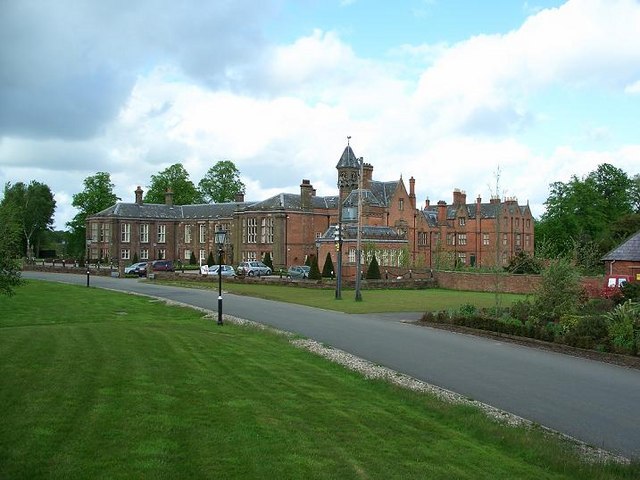
Henry II and Edward I sometimes held court in a nearby village.  Then Edward built Vale Royal Abbey between Northwich and what would become Winsford.  The Abbey fell foul of Henry VIII’s policy to dissolve all monasteries in the 16th Century.  Although the church was destroyed, the building remained intact and was eventually converted into a country manor house.  Down the centuries it became the property of the Cholmondeley family (Lords Delamare).  It is Grade II listed.


{{BotMoveToCommons|en.wikipedia}} {{Information |Description={{en|Vale Royal Abbey as it is today. The Tudor and later mansion is built around the core of the mediaeval south and west ranges of the monastery and contains surviving rooms including the abb

The importance of the Abbey is due to a late 13th Century charter which was granted allowing a new town to be formed nearby.  Yes of course the charter was given by none other than Edward I.  The new town was located where Winsford’s Delamare Street stands today and became known as Winsford.

Fast forward to the 18th Century to learn that the River Weaver, which can be found running through Winsford, was granted government permission for widening.  This allowed access for large barges coming from Liverpool to navigate to Winsford.  This meant china clay being transported from Cornwall via Liverpool could get closer to the famous Potteries in Staffordshire.  True there was still an overland journey of about 30 miles from Winsford, but the extended river journey cut travel times considerably.  This was important as the Potteries were the centre of ceramic production.


{{Information |Description={{en|1=Staffordshire pottery figure of an archer circa 1825}} |Source={{own}} |Author=Photograph taken by Andy TitcombTeapotgeorge |Date=2010-05-14 |Permission= |other_versions= }} Category:Pottery


The Potteries
The Potteries is a generic term for the villages that now make up Stoke on Trent.  Stoke on Trent isn’t only famous for its ceramic production.  As we mentioned earlier it is also the home of Digital Hearing Aids.  Now while we might not be as famous as the area once was for ceramics production, we can help anyone living in the Winsford area who has a hearing problem.  Sometimes known as Castle Hearing Aids, we can offer a country-wide service via specialists in your area.

The cause of hearing problems can be due to a number of reasons.  These range from a simple earwax build up to long-term problems.  We can arrange for an audiologist to test your ears to assess the problem and its degree of severity.  You can either make an appointment to come and see us or we can arrange for an audiologist to visit you in your own home.  The choice is yours.

Let us know which you prefer by calling us on 01782 698090.

The Salt industry
As well as sending china clay to the Potteries, locally produced salt was also sent for the production of salt-glazed stoneware.  Ceramics and stoneware were brought back following the same route to Liverpool for export.

Salt became big business in Winsford from the 19th Century due in part to the collapse of the excessively mined area under Northwich.  Many factories set up shop along the River Weaver making Winsford the largest producer of salt by the end of the century.

The salt trade remained good until the end of WWII when a decline and the introduction of new manufacturing methods meant just one company remained taking over the others.

Winsford Rock Salt Mine is the largest in the country and said to be the oldest of its kind too.  There are only three in existence, the other two being in North Yorkshire and Northern Ireland.  The rock salt is mined or quarried from150+ metres below the surface.  What is produced is a granular salt appropriately called ‘grit’ and used to de-ice road surfaces.


{{Information |Description=''no original description'' |Source=Originally from [http://en.wikipedia.org en.wikipedia]; description page is/was [http://en.wikipedia.org/w/index.php?title=Image%3AHalit-Kristalle.jpg here]. |Date= (original upload date) |Aut


Don’t forget
If you are concerned about your hearing, don’t suffer in silence!  Get in touch with us to see how we can help.  You can send us a message here or call us on 01782 698090.

Tuesday, 14 May 2013

Digital Hearing Aids Eccles – Greater Manchester Digital Hearing Aids


Digital Hearing Aids Eccles –  Greater Manchester Digital Hearing Aids

Literally just under 50 miles from Stoke on Trent, the home of Digital Hearing Aids and a mere 3.5 miles from the centre of Manchester is Eccles.  It’s part of the City of Salford and has a strange name!

How the name came about is uncertain but one popular thought is that is comes from the Latin Ecclesia meaning Christian church.  This of course dates back to the period when Britain was invaded by the Romans; the Anglo-Roman abbreviation of Ecclesia was Ecles or Eglys is thought to be the direct derivation.  Once the Anglo-Saxons arrived some place names stayed the same.  Ecles however had been used as part of several village names.  Eccles possibly derives from the original Ecles which is understood to have meant a building or site recognised as a church by the Anglo-Saxons.

Did you know?
Hearing loss can be caused by a number of conditions from earwax build-up to deterioration due to age.  We operate a service where a professional audiologist can measure the hearing loss in both ears with a simple test.  This helps to diagnose the reason and the amount of deterioration.

We can arrange for an audiologist to visit your home or make an appointment for you to visit us at our Midlands offices.  Both options are free of charge and need no commitment beyond the appointment from you.

So if you would like to arrange a visit or appointment or would just like to know more please get in touch on 01782 698090.

Eccles cakes
The first Eccles Cake was baked in Eccles in the late 18th Century.  It’s a combination of flaky pastry, butter, nutmeg, sugar, candied peel and currants.  The first person known to sell them was James Birch though there is no knowledge as to whether he actually invented the recipe.  His shop on the corner of Vicarage and St Marys Roads (now Church Street) was the first place to sell them.


{Information |Description=A freshly baked Eccles cake, taken in Bettys café. |Source=Myself. |Date=30th May 2006 |Author=Sean Whitton (User:Xyrael) |Permission="I release this work under the licenses noted below." }} 


Eccles cakes are sometimes called squashed fly cakes because of the appearance of the currants.  As there is no protection of where these cakes can be produced you might find them anywhere in the world.

The church
With a name that represents church in earlier languages, it’s not surprising to find that the town grew up around the St Mary’s Church.  Of course this is also the case for many English towns and villages as the church was the centre of communities in days gone by.


{{Information |Description={{en|1=The parish church of St. Mary, in Eccles, Greater Manchester.}} |Source=Own work by uploader |Author=Parrot of Doom |Date=16 February 2009 |Permission= |other_versions= }} <!--{{ImageUpload|full}}


St Mary’s Church wasn’t built until 13th Century much later than Roman and Anglo-Saxon occupation.  In the 1960s English Heritage designated it to Grade II listing and it has since achieved Grade I standing.

The local economy
Agriculture was the early occupation and economy of the area, probably oats and barley.  There were some local cottage industries taking place during the medieval period.  These were likely to have included blacksmithing, thatching, butchering, basket weaving, skinning, tanning and weaving.

During the 18th Century the textile industry began to have an impact.  Many of Eccles’ folks worked at home as weavers with two Manchester Mills supplying the work.  Early in the following century the majority of the population of Eccles was employed in the textile trade mainly in cotton mills.  As the century progressed two silk mills opened in Eccles and one in nearby Patricroft.  Many of the mill workers were children under twelve.

At around the same time industrialist James Nasmyth visited the Liverpool and Manchester Railway and set up his own foundry here.  He invented the steam hammer which allowed him to produce locomotives here at a speed not known beforehand.  His Bridgewater Foundry stood close to the railway and the Bridgewater Canal.  It carried on production from this time until the 1940s.  The buildings that remain are a part of the Business Park which now occupies the site.  All that is left of the foundry is one of Nasmyth’s steam hammers.


== Summary == {{Information |Description=Nasmyth steam hammer |Source=From [http://www.geograph.org.uk/photo/143999 geograph.org.uk]; transferd by User:ClemRutter using [http://toolserver.org/~magnus/geograph_org2commons.php geograph_org2commons]. |Da


As with many other places, the arrival of the railway and the canals, both the Bridgewater and the Manchester Ship Canals, Eccles thrived.  More housing was built to accommodate workers for the factories.

At the end of the 19th Century the Barton Swing Aqueduct was built.  This carried the Bridgewater Canal over the Manchester Ship Canal.  Small narrow boats can use the aqueduct on the Bridgewater Canal whilst it can move out of the way to allow larger ships to pass on the Manchester Ship Canal.  It is considered a great feat of Victorian engineering and is Grade II listed.

Famous people from the area
As Eccles is part of the City of Salford some of the famous names are attributed to the larger city.

However we do know that John Moores founder of the Littlewoods Business Empire including the retail branch of Littlewoods and the John Moores Football Pool was born here.  He gave up the chairmanship of the business in favour of his brother in 1960 so that he could become director of Everton Football Club.  He was knighted in 1970 and spent the last few years of his life in a wheelchair after prostrate troubles.  His estate following his death in 1993 was valued at more than £10 billion.  Liverpool Polytechnic took the name of Liverpool John Moores University when it was granted the status in his honour.

Film director Mike Leigh known for his gritty script-less films and plays was brought up in the area.

Actor Robert Powell best known for his film roles as John Hannay (The 39 Steps) and Jesus of Nazareth in the film of the same name and Mark Williams in the TV series Holby City comes from here.

As does Russell Watson a Classical English tenor who found fame in popular music.


{{BotMoveToCommons|en.wikipedia}} {{Information |Description={{en|Russell Watson 2007 - Broadlands Hampshire England Image: Peter French at Flying Tigers Studio www.flyingtigers.co.uk}} |Source=Transfered from [http://en.wikipedia.org en.wikipedia] Trans


Manchester United player Ryan Griggs has lived in the area since he was six years old.

The creator of Coronation Street Tony Warren hails from the area.

Journalist and broadcaster Alistair Cooke most famous for his radio programme Letter from America was also from the area.

Allan Clarke was the original singer with the 1960s pop group The Hollies.

Graham Nash singer/songwriter with 1960s/70s band Crosby, Stills, Nash & Young comes from the area.

Suffragette Emmerline Pankhurst also hails from the area.  She founded of the Women’s Social and Political Union and was instrumental in winning the vote for women.

Current residents of Eccles ...
... lend me your ears.  In a manner of speaking that is.  If your hearing is failing you and you’d like to help to hear better, get in touch with us either via our online form or by calling us on 01782 698090.

Monday, 29 April 2013

Digital Hearing Aids Cheadle Hulme – Greater Manchester Digital Hearing Aids


Digital Hearing Aids Cheadle Hulme – Greater Manchester Digital Hearing Aids 

Cheadle Hulme is commuter territory.  It is less than 10 miles to Manchester which is the destination for most of the commuters.  Interestingly Cheadle Hulme started life hundreds of years ago as a series of hamlets and unlike most towns and cities wasn’t built around a church.

In the Domesday Book it was part of a large estate which included Cheadle and was valued at just £20.  Although there were signs of Bronze Age settlers and Romans, Cheadle Hulme’s first owner was the Earl of Chester.  In the 13th Century the area became the property of the Chedle family but they took their name from the area not vice versa.  Through the centuries, Cheadle Hulme and Cheadle had a chequered history of ownership.  The estate was split in two hence Cheadle Hulme in the south and Cheadle in the north.

White noise
Fly in your ear?  Or just white noise?  Yes if you’re having trouble hearing us correctly maybe you need some help.  Hearing impairment can be caused by a number of conditions from heredity disposition, ear wax, constant abuse by loud noises and of course deterioration as you age.

At Castle Hearing Aids we can help you identify the cause of your problem with the help of a professional audiologist who will test both ears.  From there we can assess how we might be able to help you further with digital hearing aids.  If you’d like to arrange for a test or learn more, please call us on 01782 698090.

Ancient buildings
Cheadle Hulme has other ancients besides you! Yes some of its buildings go back a long way.  Bramall Hall for instance dates from the 14th Century so it’s little wonder that it has Grade I listing.  (It’s a shame we can’t claim similar credence when we reach a certain age!)


Bramall Hall is a Tudor manor house complete with signature black and white timber frame.  It can be found at the heart of 70 acres landscaped parkland, a conservation area.  The general public are welcomed in both the park and the house.

An area in Cheadle Hulme namely Swann Lane, Hulme Hall Road and Hill Top Avenue also form a conservation area with 16th and 17th Century buildings with timber frames and Victorian homes.  The area also boasts two Grade II listed buildings, Hulme Hall, another timber framed manor house and 1 Higham Street.  The latter was once known as Hill Cottage and is built in a similar style to Hulme Hall, both date from 16th or 17th Century.  Hulme Hall is now a nursing home.

The 17th Century Millington Hall is also Grade II listed.  When you’re looking for it now, you’ll find it renamed as the John Millington pub!


The Kings Hall pub in Station Road only dates back to the 1930s when it was a dance hall complete with stage and orchestra pit.  During the 1960s some of the best know Liverpool bands played here – we wonder which ones?  Now it’s a pub.

Beautiful scenery
There are two main parks in the area.  Oak Meadow Park is in the centre of town and is mainly grass and woodland.  It’s a welcoming space to take a walk or relax in.  Many community projects use the park for annual events.

If you’re looking for somewhere with lots of activities then Bruntwood Park is the place.  The original manor house Bruntwood Hall built in the 19th Century is now offices but the park offers lots of fun activities from an 18 hole pitch and put course to a BMX track, football pitches to kids’ play areas.

War effort
Cheadle Hulme was host to evacuees in the Second World War from both Manchester and the Channel Islands.

RAF Handforth was a supply post during the war making sure that the RAF had everything they needed from knives and forks to engines.

Rich and famous
Cheadle Hulme has been responsible for some famous people over the years:

·         Tim McInnery aka Lord Percy in Black Adder was born in Cheadle Hulme.  Of course he has appeared in many productions apart from Black Adder including films Notting Hill and 101 Dalmatians, TV productions Spooks, Hustle and Dr Who.


·         Actress Kirsten Cassidy is best known for her role as Tania Young in Grange Hill.  Before that her roles were mostly in the theatre – Wind in the Willows, Our day Out and The Sound of Music.  She can now be seen appearing in Coronation Street.  She is playing a sixth former known for her flirting.


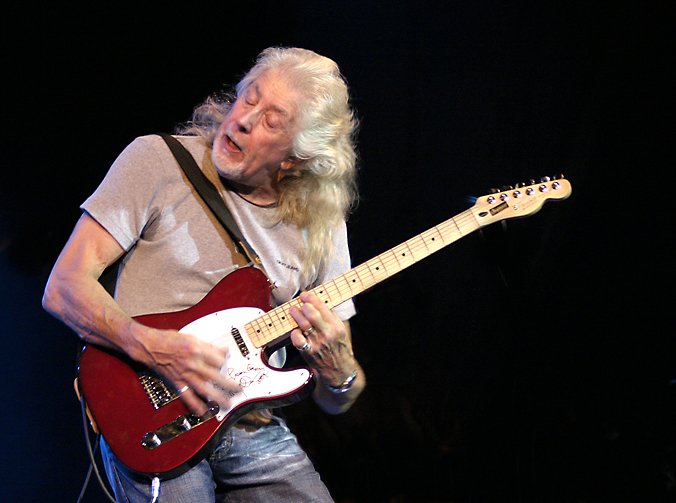
·         In 1933 John Mayall was born here.  He was later to become a blues singer and self-taught guitarist, pianist and harmonica player and went onto to have a prolific recording career which started in 1965 until the present day.  Over the years he has worked with other famous names including Eric Clapton, Peter Green, Mick Fleetwood and Mick Taylor.


·         Mathematician Patrick du Val who was born in 1903 was a sickly child and was mostly home-schooled.  Later he was accepted at Trinity College Cambridge where he studied for a PhD.  His model of algebraic  geometry the ‘du Val singularity’ was named after him.


·         Violinist Jennifer Pike won the title of Young Musician of the Year when she was twelve years old.  After this achievement she went onto play at a number of major venues.  She won a scholarship to the Guildhall School of Music and Drama.  She is currently attending Lady Margaret Hall, Oxford studying – you guessed - music.


·         Cheadle Hulme is also the birthplace of the founder of the Women’s Royal Air Force, Felicity Peake.


Which bands did you hear?
Did you see and hear the Beatles play in Cheadle Hulme in the 1960s?  Or was it The Searchers or the Merseybeats?  Bet you hearing was up for it then.


If now your hearing ain’t what it used to be, don’t suffer in silence, get in touch with us.  Remember we can organise an audiologist to come out to you to test your ears or of course you can come to us.  You can email us via the website or give us a call on 01782 698090.

Thursday, 18 April 2013

Digital Hearing Aids Altringham – Greater Manchester Digital Hearing Aids


Digital Hearing Aids Altringham – Greater Manchester Digital Hearing Aids 

A mere 8 miles south west of Manchester you’ll find Altringham which is now an affluent commuter market town.

It seems there has been life in Altringham, or at least where the town now sits, since prehistoric times.  Neolithic arrowheads have been found there.  Also part of a very important Roman road that linked Chester to York runs through the Broadheath district of the town.


Altringham got its market charter once the Normans invaded Britain. There is no mention of the town in the Domesday Book but the area was ‘owned’ by Hamon de Massey.  He granted the borough a free charter for a market at the end of the 13th Century.  This is the first official mention of Altringham – or Altrincham as it was spelt then – in any records.  It is very likely that Massey established the market and planned the town as a way of collecting taxes.  It was unusual to find planned market towns at this period in history.

Like many other towns in the area, Altringham originally relied on agriculture as its main source of income.  At the beginning of the 19th Century the textile industry had a presence in the area and Altringham had four cotton mills, however these were soon lost to other areas nearby.


By the beginning of the First World War Altringham had established a thriving industrial area in Blackheath.  Companies mainly focusing on heavier industry such as the Budenberg Gauge Company, Tilghmans Sand Blast and the Linotype and Machinery Company established their businesses here.

History lives on
The Old Market Place in Altringham is probably the site of the original town.  The area has several part timber framed buildings and is now a conservation area.  In fact ten of the 21 conservation areas in Trafford are in Altringham. That’s quite some count.

Altringham used to have a Buttermarket too.  This seems to have been a very important place in the local community.  It was used as a place of justice; there was a courtroom above the market and stocks and a whipping post here were all used to keep order.  In front of the market there was also a market cross where local couples made their declarations of love and their intentions official – a sort place of engagement.  Unfortunately the Buttermarket ceased to exist during the 19th Century.  The town lost a real historic treasure.  Local traders reinstated a whipping post and stocks in the 1990s to attract tourists.

The Old Market Place was where the ancient market was held.  Nowadays a market is still held every Tuesday, Friday and Saturday in the listed Market Hall which was built in 1930.  There are other markets held here at other times – a Farmers  Market, a craft market and an antiques market.

Did you know?
In the 1830’s a man sold his wife here for the equivalent of 7.5p.  He believed this was completely legal as long as he provided a halter to go over her head!  Charming!

This probably wasn’t quite as strange as it sounds.  Thomas Hardy’s The Mayor of Casterbridge starts off with a ‘wife sale’.  He wrote this book in the 1880s.  Thank goodness times have changed.

What did you say?
Eh did you hear that right?  Yes you did!  Selling your wife or husband in the market place certainly isn’t legal now.

But if you’re concerned about the quality of your hearing, we can arrange for a professional audiologist to test both of your ears.  This will assess any damage or deterioration so that we are then in a position to advise you on a course of action.

The test is simple.  The audiologist tests both ears using tonal sounds and records the response using a computerised system.  See what others say.

If you’d like to know more or set up an appointment give us at Hearing Aids Stoke on Trent a call on 01782 698090.

Houses of Interest
Nearby Dunham Massey Hall, built in the 18th Century, was once home to the Earl of Stamford.  Its current owner is the National Trust and has been since 1976.

There is evidence of the early existence of this building as it appeared in the Domesday Book.  In fact there are as many as 45 buildings on the site that are all Grade II listed.  It is said to have belonged to a Saxon nobleman, Aelfward and when the Normans came it was taken over by Hamon de Massey.  It remained the family seat of the Masseys until the 14th Century when there were no heirs to carry on the family line.

The current building was built in the 17th Century for the Earl of Warrington.  Alterations were made some hundred years later, when the family had merged by marriage to the Stamford line making the title Earl of Stamford and Warrington.  The house is surrounded by a moat and a deer park.

Royd House
This much newer building was built at the beginning of the 20th Century by a local architect as his home.  He was Edgar Wood who was influenced by the Arts and Crafts Movement and Art Nouveau.
Royd House has a flat concrete roof and was very forward-looking for the time.  It is now Grade I listed.


A disused Christian Scientist Church that he designed is now a cultural centre in Manchester bearing his name.

People you might know
Considering Altringham’s affluence there only seem to be a few notable people connected to this town.  Some you might know are:

·         The 19th Century artist Helen Allingham grew up in Altringham.  She became well known for her paintings of the Surrey and Sussex countryside where she lived later in life


·         Author of the Little Grey Rabbit books, Alison Uttley.  She wrote over a 100 books

·         Dramatist Ronald Gow who is best remembered for his production of Walter Greenwood’s book, Love on the Dole

·         Angela Cartwright, the actress who starred as Brigitta Von Trapp in the Sound of Music film and appeared as Penny in the 1960’s TV series Lost in Space


·         Two of the Stone Roses were educated at Altringham Grammar School, namely Ian Brown and John Squire

·         The Red Dean of Canterbury, Hewlet Johnson started his career as curate at St Margaret’s Church in Altringham.  He set up a hospital with his wife for wounded soldiers returning from the First World War.  As a committed Christian Marxist he supported Russia which is how he gained his nick name


We are just a phone call away
Yes all it takes is a phone call or an online message and we can help you with your hearing problem.  Don’t waste any more time being frustrated with your ability – or lack of – to hear clearly.  Send us a message or call us on 01782 698090.

Friday, 12 April 2013

Digital Hearing Aids Wilmslow – Cheshire Digital Hearing Aids


Digital Hearing Aids Wilmslow – Cheshire Digital Hearing Aids 

Affluent Wilmslow just 11 miles south of Manchester is famous for its ‘Cheshire lifestyle’.  The expensive houses, designer shops and good restaurants are magnets for famous footballers and of course their wives and families.  This also helps to attract other ‘wannabe’s’ to the area.

In fact Wilmslow lies within the Golden Triangle of well-heeled locations in this area, which also include Alderney Edge and other villages such as Knutsford and Prestbury.  Not surprisingly this is a Conservative stronghold with the current parliamentary representative George Osborne, also holding the post of Chancellor.


When the railways arrived in the area back in Victorian times it made Wilmslow commutable.  This enabled the wealthy businessmen of the time to move out of Manchester and so the bar was set.  It has remained a ‘desirable’ location to live ever since.


Football fever
Back in 1924 before Wilmslow and the surrounding area became the home of choice to our top professional football players, two brothers set up a workshop in the town to produce sports wear.  Harold Humphreys, one of the brothers, had seen the way football was fast becoming a national obsession.  One example being how crowds in excess of 200,000 flocked to the cup final at Wembley in the previous year.  He took his tailoring skills and set up the company, Umbro an acronym of Humphrey Brothers.


Their first football kit was produced for the FA Cup in 1934 between Manchester City and Portsmouth.  Both teams wore kit by Umbro and they became the official FA Cup supplier and sponsor of the Football Association.

Over the years Umbro has provided uniforms for the British Olympic team, tennis and produced other sports gear.  The company started to produce their own football boots in the 1980s.  Umbro has supplied kits globally to a number of different football playing countries.  Having sold to Nike Inc in 2007, they have now been sold onto Iconix.

Umbro has sponsored many footballers over the years including Denis Law (Manchester United and Scotland), Alan Shearer (Newcastle United and England) and Michael Owen  at the age of 14 (Manchester United and England).  Currently they sponsor England players Joe Hart, Andy Caroll, Andre Wisdom and Kevin Nolan.  They also sponsor Peruvian player Juan Vargas and a number of teams in the UK and all around the world.


Earlier residents
Nearby Lindow Moss turned out to be the long-term home of an ancient resident of the area.  The body which had been preserved by the peat bog was found in 1984 when professional peat cutters were going about their work.  The previous year Lindow Woman – or at least her head -had been found in the same area.


Lindow Man has been identified as a healthy male (when he was alive obviously) in his 20s who appears to have met with a violent death.  He was strangled and hit on the head and as if that wasn’t enough, his throat was cut.  Brutal to say the least.  The body and the head have been radiocarbon dated as being around 2000 years old making them from the Iron Age.  Lindow Man who is sometimes referred to as ‘Pete Marsh’ has been preserved by freeze drying.  He is on show at the Manchester Museum if you want to meet him.

Sorry I didn’t catch that
Well one thing’s for certain poor old Lindow Man certainly can’t hear anymore.  Reduced hearing is sometimes caused by the ears being blocked by wax, but we’re guessing it was peat in his case.
How are yours?  Hearing Aids Stoke-on-Trent has all the expertise to assess you.  Failing hearing can be due to many things – though rarely peat blocking – and can happen at any time in your life.  Don’t suffer in silence, let us help you.  We are just at the end of a telephone line (01782 698090) and waiting for your call.

Wilmslow makes the headlines
In 1997 two IRA bombs went off on the rail tracks near Wilmslow railway station; fortunately no one was hurt although there was extensive damage.

Famous residents of Wilmslow
As we’ve said Wilmslow attracts many notable people to this desirable area.  As well as footballers, actors and show business personalities are also fond of the town.  Here’s a few that we know of:

·         Long-serving Coronation Street actor William Roache known for his role as Ken Barlow

·         Sir Alex Ferguson long time manager of Manchester United

·         Kerry Katona who initially made her name as part of girl band Atomic Kitten

·         Tenor Russell Watson who had two brain tumours that interrupted his singing career in 2005 and 2007

·         There’s a blue plaque on the wall outside the former home of Alan Turing here who was instrumental in developing computer science


·         Author Alan Garner famous for his children’s books is a local resident

·         Another Coronation Street  actor who lives here is Simon Gregson famous for his part as Steve MacDonald

·         South Korean footballer Park Ji-Sung made his home here too during his time at Manchester United.  He currently plays for Queens Park Rangers

·         More players living the footballer’s lifestyle in Wilmslow include Manchester United players Nemanja Vidic, Luis Nani, Antonio Valencia, Phil Jones, Federico Macheda, Patrice Evra, Ashley Young and of course, Wayne Rooney

·         Manchester City players living here include Yava Toure, Joleon Lescott, David Silva, Joe Hart and Gareth Barry


Sending up a cheer
Wilmslow is like football city!  Can you hear the cheers from where you live?  If you’re having trouble with that maybe it’s time to get a hearing test.  We can offer you a professional audiologist to test both ears – it’s important to test both – so that we can assess how we can help.  Digital hearing aids for both ears make a world of difference and really help you to hear better.
This has to be tempting.  Give us a call on 01782 698090 or make an online enquiry here so that we can get the ball rolling!